


Utility right-of-way (ROW) — power-line corridors, pipelines, rail embankments — demands disciplined vegetation management for safety and reliability. This utility ROW vegetation management guide covers the clearance challenge, why remote control flail mowers fit, model selection, compliance with clearance rules, and a procurement checklist.
The clearance challenge
- Reliability: trees and brush into lines cause outages and fires.
- Access: corridors run through slopes, wetlands and remote ground.
- Safety: manned cutting near live lines is high-risk.
- Frequency: clearance is recurring, not one-off.
Why remote control flail mowers fit ROW
A flail unit shreds saplings, brambles and tall growth that a rotary deck bogs down in, and a tracked chassis reaches slopes a ride-on cannot. The operator stays clear of the hazard and of traffic — critical along live corridors.
Model selection for ROW
| Corridor | Recommended model | Why |
|---|---|---|
| Power-line verge, brush | F1000 (flail) | Shreds brush, operator clear |
| Pipeline / rail embankment | T550 (tracked) | Climbs banks, stable |
| Access track, light growth | W500 (wheeled) | Flat, low cost |
Compliance with clearance rules
Most regions set mandatory clearance distances from lines and structures. A repeatable, recorded process — not variable crew judgment — keeps you defensible. Confirm the marks your market requires (CE / RED, local utility standards) and document each pass.
Procurement checklist
- Map corridors by slope, brush density and access.
- Specify flail vs rotary by dominant growth.
- Confirm tracked reach for embankments.
- Plan spares and operator training for remote sites.
- Trial a sample on a representative corridor segment.
ROI vs contract clearing
Recurring clearance across a network is exactly where ownership pays: control over schedule, safety narrative and records, typically recovering in one to two seasons versus contracted cutting. See our cost vs crew comparison.
Checklist: before you buy
- Confirm required clearance distances and marks.
- Decide flail / tracked / wheeled mix.
- Budget training, spares, transport to sites.
- Trial on your hardest corridor segment.
Frequently asked questions
Q: Can it clear young trees from a line corridor?
A: A heavy flail deck shreds saplings up to a few cm; larger stock needs staged clearing.
Q: Is it safe near live lines?
A: The operator works at a safe distance with e-stop; never closer than the rated clearance.
Q: Flail or rotary for ROW?
A: Flail for brush and saplings; rotary only for finished turf.
Q: Can it reach pipeline embankments?
A: A tracked unit like the T550 climbs banks a ride-on cannot.
Q: How does it help compliance?
A: A recorded, repeatable process is defensible versus variable crew judgment.
Q: What spares to stock?
A: Flail hammers, belts, tracks, filters, remote batteries.
Q: Recurring cost vs contractor?
A: Ownership usually wins within 1–2 seasons on a network.
Q: How do I start?
A: Contact RCVIX with corridor map, slope and growth.
Compliance & environmental rules for vegetation management
Right-of-way and corridor work is regulated. Before you cut, confirm the rules that apply to your network:
- Protected species & buffer zones: some corridors cross habitats with no-cut windows or setback distances — map them first.
- Fire-season windows: many utilities run vegetation control inside defined burn-risk periods; outside those, access may be restricted.
- Herbicide limits: where chemical follow-up is used, obey local application rules, setbacks from water and re-entry intervals.
- Permit & audit logging: keep records of what was cut, where and when — auditors and insurers expect it.
- Access rights: gates, easements and landowner permissions must be in place before crews enter.
A remote control flail lets a small crew clear long corridors with the operator clear of falling brush and road traffic. See our safety guide.
Fleet sizing & corridor scheduling
| Corridor length | Recommended units | Crew model |
|---|---|---|
| Up to 10 km | 1–2 F1000 flail | 1 operator + spotter |
| 10–50 km | 2–3 flail + 1 tracked | 2 operators, rotating |
| 50+ km / grid | Mixed fleet, spares on truck | Shift teams |
Schedule by vegetation regrowth rate, not the calendar: fast-growing brush corridors need a shorter cycle than open grassland. Plan fuel, blades and a service window so a jammed unit does not stop the program.
Next step
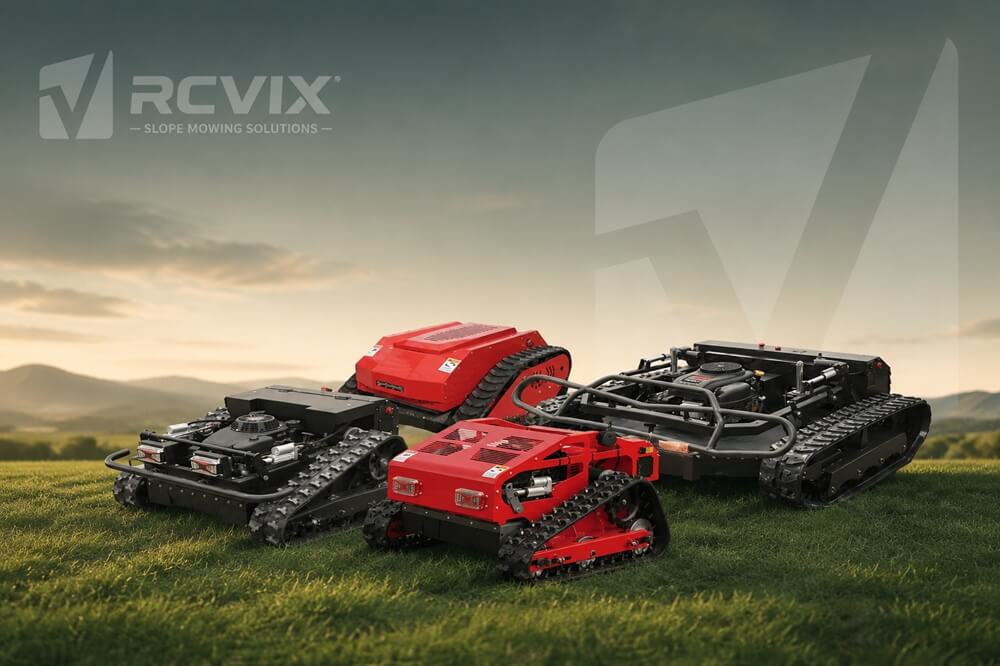
For a ROW model plan, contact RCVIX. Review F1000, T550 and W500 specifications.

Related Products
Professional-grade solutions for your operational requirements


Related Articles
Frequently Asked Questions
Yes. Relevant shipping documents such as commercial invoices, packing lists, and transport documentation will be provided according to the shipment arrangement. Tracking information is provided where available through the logistics provider.
Yes. Detailed technical documentation, including specification sheets, configuration options, and operational parameters, can be provided during the quotation stage upon request. For OEM/ODM projects, engineering drawings and design documentation can also be shared under confidentiality agreement.
Yes. RCVIX provides OEM and private label manufacturing services for qualified business partners. Branding, color schemes, labeling, and certain technical configurations may be customized according to project requirements.
Yes. Each machine is delivered with an operation manual and safety guidelines. Additional training materials or remote technical guidance may be provided depending on project requirements and customer agreement.
Need a Custom Solution?
Our team of experts is ready to help you find the perfect vegetation management solution for your specific needs. Get a free consultation and quote today.
