


The biggest safety win of a remote control mower is also its biggest trap: because the operator stands clear of the machine, it is easy to forget the cutting head is still a lethal, fast-spinning hazard. Safe operation is a set of non-negotiable habits — PPE, line-of-sight, emergency stop, and slope discipline. This guide sets the rules we train every operator on.
Personal protective equipment (PPE)
- Eye protection: debris flies — always.
- Hearing protection: gas engines run loud for hours.
- Footwear: boots with grip; no open shoes on a slope.
- Gloves: for handling blades and the unit; keep rings off.
- Hi-vis: when working near roads or other crews.
Line-of-sight and the operator station
Never let the unit drop below your sightline on a blind bank or behind dense rows. Keep the transmitter in hand with a firm grip, and stand where you can see the cutting path and any bystanders. If you lose sight, stop — a remote control mower with no eyes on it is a runaway risk.
Emergency stop is a reflex, not a backup
- Test the e-stop before every session and after any drop or impact.
- Know which switch kills drive and blades together.
- Make sure helpers and nearby workers know where it is.
Slope discipline
- Stay within the rated angle. A slope-rated tracked unit is not a license to climb a scree slope; judge the substrate, not just the number.
- Mow across or in controlled passes, never straight down a slick face.
- Keep the operator on stable ground — the whole point of RC is that the person is not on the machine.
- Avoid fresh rain on banks; wet clay and loose soil cut traction sharply.
Bystanders, animals and obstacles
- Keep people and pets outside the operating arc and the throw radius.
- Walk the area first for holes, wire, unstable edges and hidden debris.
- Mark known cable and irrigation runs; steer around them.
Transport and refuel
- Cool the engine before refueling gas units; no smoking.
- Secure the unit when trailering; latch the deck.
- Store the transmitter dry; a wet pack can drop the link at the worst moment.
| Rule | Why it matters |
|---|---|
| PPE on | Debris, noise, slip on slope |
| Eyes on unit | No runaway, no surprise |
| E-stop tested | Reflex, not backup |
| Within rated slope | Traction and rollover control |
| Clear bystanders | Throw radius is real |
Frequently asked questions
Q: Can a second person help?
A: Yes — one operates, one watches the far side and manages bystanders. Never have two people issue commands to one unit.
Q: What if the unit starts sliding?
A: Hit e-stop, then move clear. Do not chase it. Once stopped, assess before approaching.
Q: Is it safe on public verges?
A: Only with traffic control, hi-vis and a spotter; close the lane or work off-peak.
Next step
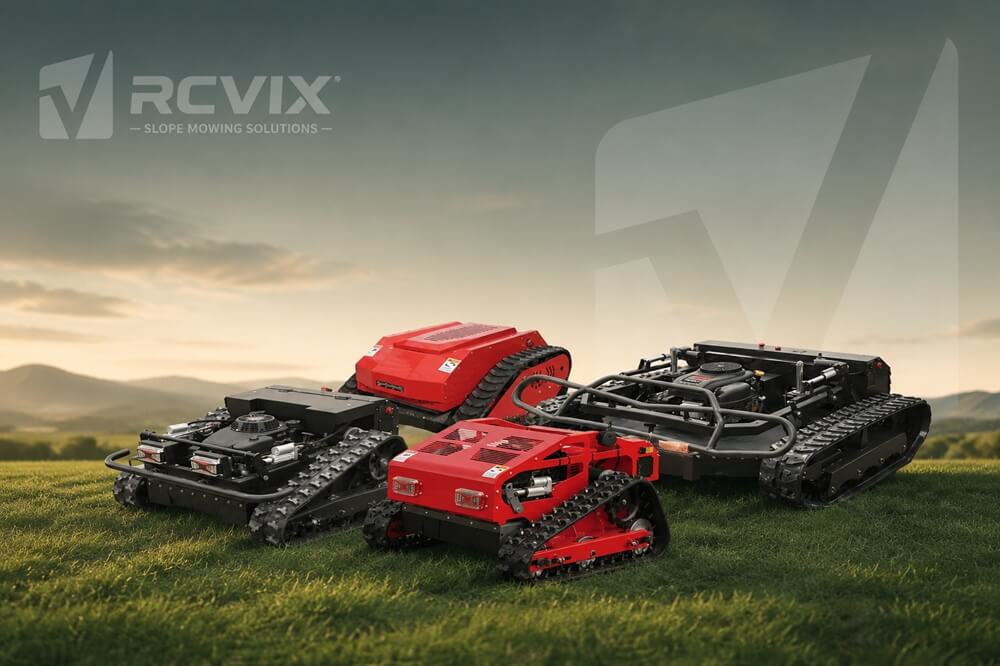
If you equip a crew or train operators, our T550, W500 and F1000 ship with a safety card. Dealers get operator training material — see the distributor program or contact us.

Related Products
Professional-grade solutions for your operational requirements


Related Articles
Frequently Asked Questions
Yes. Our machines are designed to operate on a variety of terrains including grassland, uneven ground, slopes, and partially rough environments. However, optimal performance depends on selecting the appropriate model for the specific working conditions.
Yes. Each machine is supplied with an operation manual and basic safety guidance documentation. Additional technical support or operational guidance may be available depending on the project and cooperation agreement.
Yes. Our engineering team supports OEM/ODM development projects including structural modifications, functional adjustments, and application-specific configurations for industrial customers.
Payment terms are specified in the Proforma Invoice (PI) or sales contract. In most cases, production begins after receipt of the agreed deposit payment, with the remaining balance payable before shipment unless otherwise agreed.
Need a Custom Solution?
Our team of experts is ready to help you find the perfect vegetation management solution for your specific needs. Get a free consultation and quote today.
