


A remote control mower manufacturer designs and builds radio-controlled slope mowers - the tracked or wheeled machines an operator runs from up to 200 metres away to cut grass on terrain a ride-on mower can't safely reach. If you're a distributor, landscaper, or brand owner sourcing these units, the manufacturer you pick decides your warranty claims, your CE paperwork, and whether your first container sells or sits in a warehouse. This guide walks through what actually separates a capable RC-mower builder from a trading company with a catalogue, drawn from what distributors run into in the field.
Match the Manufacturer to Your Business Model
Before you compare factories, pin down how you'll sell. The right partner for a German landscaping contractor buying fleet units is not the right partner for a startup launching a private-label brand in France.
- Reseller / distributor: you want proven SKUs, spare-parts availability, and marketing assets. Customization matters less than reliability and stock depth.
- OEM: you bring drawings or specs; the factory builds to them. You need real engineering capacity, not just final assembly.
- ODM: you adopt the factory's existing design under your brand. Speed-to-market beats uniqueness.
- Private label: an exclusive build with your livery, manual, and packaging. You need branding and documentation support, not necessarily a custom chassis.
Get this wrong and you'll either overpay for capacity you don't use or under-spec a partner who can't deliver your model. The evaluation criteria below weigh differently depending on which box you ticked.
The Certification Checklist (Non-Negotiable for EU / UK / North America)
Compliance isn't paperwork theatre - it's what lets you clear customs and what protects you when a unit fails in the field. For RC mowers, expect:
- CE marking under the Machinery Directive 2006/42/EC - covers the cutting deck, physical guards, and the emergency-stop logic. This is the baseline for the EU market.
- Radio Equipment Directive (RED) 2014/53/EU - the remote control itself transmits on licensed bands; without RED conformity the entire product is non-compliant in the EU, even if the mower deck is perfect.
- EMC (Electromagnetic Compatibility) - so the remote doesn't drop out near power lines or interfere with other site equipment.
- RoHS and WEEE - material restrictions and end-of-life handling.
- ISO 9001 - a quality-management baseline. Not a product cert, but a signal the production line is controlled rather than ad-hoc.
- ISO 11806 / EN 15533 - pedestrian- and remote-controlled mower safety standards. Ask whether their test rig actually validates tilt-cutoff and emergency stop, not just paperwork.
A manufacturer who says "CE is optional" or "we can add it later" is telling you they've never shipped to a regulated market. Walk away.
Questions That Separate Factories from Trading Companies
Trading companies resell other people's units and often can't answer these:
- Do you own the injection tooling and the controller firmware, or source both? A builder owns its RF stack; a trader doesn't.
- Can we audit the production line - not a showroom, the line? Capable factories schedule this; traders deflect.
- What's your first-pass yield on final assembly, and how do you track defects per batch? Real quality management has a number.
- Who writes the multilingual manual and the EC declaration of conformity? If the answer is "you provide it," you're buying hardware, not a compliant product.
In our experience supplying distributors across Germany, France and North America, the partners who survive year three are the ones who can talk through their own controller board - not a sales deck.
MOQ, Lead Time, and the Logistics Reality
Numbers vary by model and customization, but here's what's normal for RC mowers so you can smell a lie:
- MOQ: 20-50 units for stock SKUs; 100-200 for a private-label run with custom livery and packaging.
- Lead time: 25-40 days for standard models; 45-55 days once tooling or firmware changes enter the build.
- Sea freight: 30-45 days to a European port, plus 5-10 days customs and last-mile. Budget a full quarter from purchase order to shelf.
A quote promising 10-unit MOQ with 15-day delivery on a "fully customized" unit is almost always a trader drop-shipping from a marketplace. That's fine for a sample; it's a liability at scale.
Red Flags We've Learned to Watch
Some patterns show up repeatedly in failed sourcing attempts:
- No EC declaration or CE test reports on request - only a "CE certificate" image that doesn't name the exact model.
- Refuses a live line audit but offers a polished office tour.
- Vague on controller origin ("it's standard") - RF is the single most failure-prone subsystem on these machines.
- Won't provide a spare-parts list with part numbers, so you can't service units after sale.
- Pushes you to skip certification "to save cost" - the savings land on your customer, as a customs seizure.
None of these is disqualifying alone, but three or more means stop.
Trading Company vs Generic Factory vs RC-Mower Specialist
| Criterion | Trading Co. | General Lawn-Equipment Factory | RC-Mower Specialist |
|---|---|---|---|
| Controller & RF ownership | None (resells) | Often outsourced | In-house |
| Certification support | Weak | Moderate | Strong (RED/CE docs) |
| Slope / terrain expertise | Generic | Limited | Deep (≤35° testing) |
| Spare-parts program | Ad hoc | Variable | Structured, coded |
| MOQ flexibility | High | Medium | Medium (tooling-bound) |
| After-sales engineering | Minimal | Limited | Direct |
Why a Dedicated RC-Mower Specialist Usually Wins
General lawn-equipment factories make ride-ons and walk-behinds; RC slope mowers are a different discipline. The remote link, the tilt safety logic, and track-based traction on 30°+ grades are their own engineering problem - and a specialist lives in that problem daily. That shows up as fewer radio dropouts, cleaner emergency-stop behaviour, and a parts catalogue you can actually order from.
If your volume is modest, a generalist may be cheaper per unit - but the support gap shows up the first time a controller fails mid-season, when your customer is standing in tall grass with a dead machine. Match the partner to the consequence you can't afford.
Your 10-Point Audit Checklist
Before you sign anything:
- Request the EC declaration naming your exact model, not a generic family.
- Confirm RED + EMC test reports for the remote control unit.
- Book a live line audit - a video walk-through is the minimum.
- Get first-pass yield and defect-tracking numbers in writing.
- Review the multilingual manual draft before tooling locks.
- Lock the spare-parts list with codes and lead times.
- Clarify the warranty split: unit vs controller vs battery.
- Confirm customization scope (livery, packaging, firmware).
- Price the full landed cost, not just EXW.
- Talk to one existing distributor reference you found yourself, not one they arrange.
Frequently Asked Questions
Q: Can I import RC mowers without CE into Europe?
A: Not legally for resale. Customs and market-surveillance authorities can seize non-CE units, and your liability if one injures someone is effectively unlimited. CE isn't optional for the EU market - it's the cost of entry.
Q: How do I verify a factory is real and capable?
A: A live line audit plus a request for the actual test reports naming your model. Trading companies stall on both, because neither exists on their side.
Q: What's a realistic MOQ for a private-label run?
A: Typically 100-200 units once custom livery and packaging enter the build; stock SKUs start around 20-50. Below that, you're usually buying a trader's shelf stock.
Q: Who handles warranty - me or the manufacturer?
A: Usually split: you handle front-line support in-region; the manufacturer covers defects on unit, controller, and battery per agreed terms. Get that split in writing before the first container.
Q: How long until I can actually sell?
A: Plan a quarter. 25-55 days build plus 30-45 days sea freight plus customs. Air freight cuts transit but multiplies cost - reserve it for samples and emergency stock, not volume.
Where RCVIX Fits
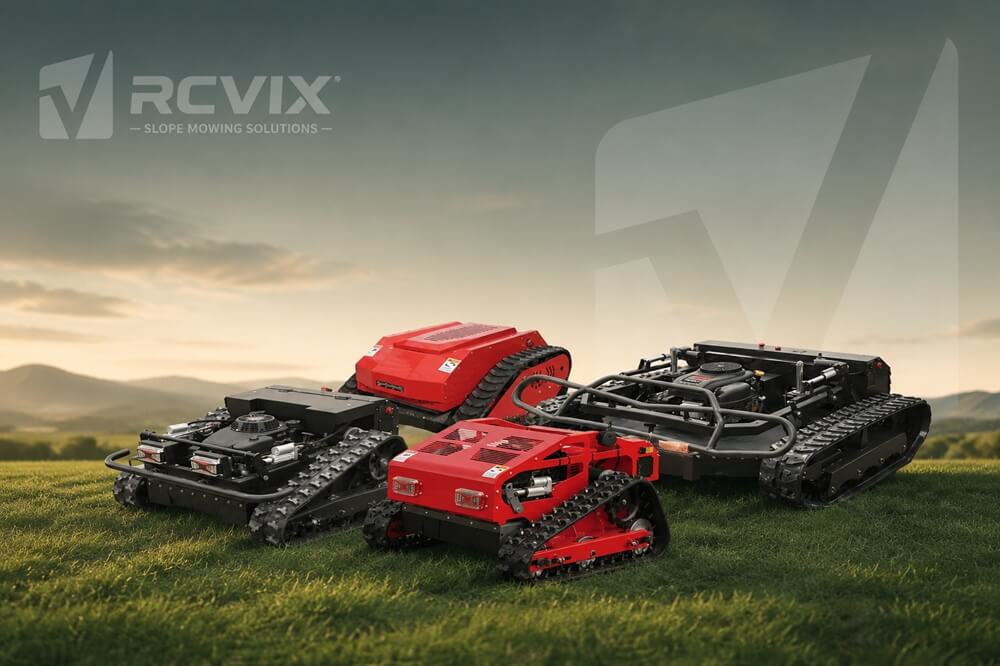
RCVIX builds remote control mowers as our core product line - not a side category - and runs OEM, ODM and private-label programs with CE/RED documentation, multilingual manuals, and a structured spare-parts catalogue. If you're weighing a manufacturing partner, our engineering team can walk you through the audit checklist above against our own line.
See the become-a-distributor guide and the OEM / ODM explainer, or contact us to talk through your model and volume.

Related Products
Professional-grade solutions for your operational requirements


Related Articles
Frequently Asked Questions
Quotation validity depends on market conditions, material costs, and currency fluctuations. Typically, quotations remain valid for a limited period specified in the offer document. For long-term projects, pricing may be subject to adjustment.
RCVIX operates strictly as a B2B supplier. Our products are designed for professional, commercial, and industrial use. We do not market or sell directly to individual consumers unless under specific project-based agreements.
Shipping insurance availability depends on the selected shipping terms and transportation arrangement. Under certain Incoterms such as CIF, insurance may be included. Additional insurance options can be discussed during order confirmation.
Yes. RCVIX supports long-term cooperation models with distributors, dealers, and industrial partners. For strategic partnerships, we can establish stable pricing frameworks based on forecasted demand and volume commitments.
Need a Custom Solution?
Our team of experts is ready to help you find the perfect vegetation management solution for your specific needs. Get a free consultation and quote today.
