


A remote control mower is a bigger decision than a lawn tractor because it leaves the operator on the ground and puts the work on a tracked or wheeled unit you drive from a transmitter. That change unlocks slopes, brush and tight rows — but only if you pick the right spec. Use this checklist to turn a confusing shortlist into one machine you will not regret.
1. Start with the ground
- Slope: measure the steepest face you must cut. If it is beyond ~15°, you need a tracked, slope-rated unit, not a wheeled one.
- Surface: grass only, or brush, saplings, orchad suckers? Brush and stalks call for a flail head.
- Access: gate and row widths decide how narrow the unit can be.
2. Match the cutting system
| Rotary | Flail | |
|---|---|---|
| Best for | Fine turf, clean grass | Brush, stalks, rough growth |
| Finish | Clean, even | Mulched fine |
| Clog risk | Lower on soft growth | Lower on coarse growth |
Many buyers choose flail because orchards, solar sites and embankments mix grass with woody growth.
3. Power source: gasoline, hybrid or electric
- Gasoline / hybrid: longest uninterrupted runtime, best for all-day site and farm work.
- Pure electric: quiet, zero exhaust, ideal for enclosed, fenced or noise-sensitive blocks.
Pick by daily runtime, not by trend. If a single charge will not cover your longest day, hybrid is the safer call.
4. Size the cutting width
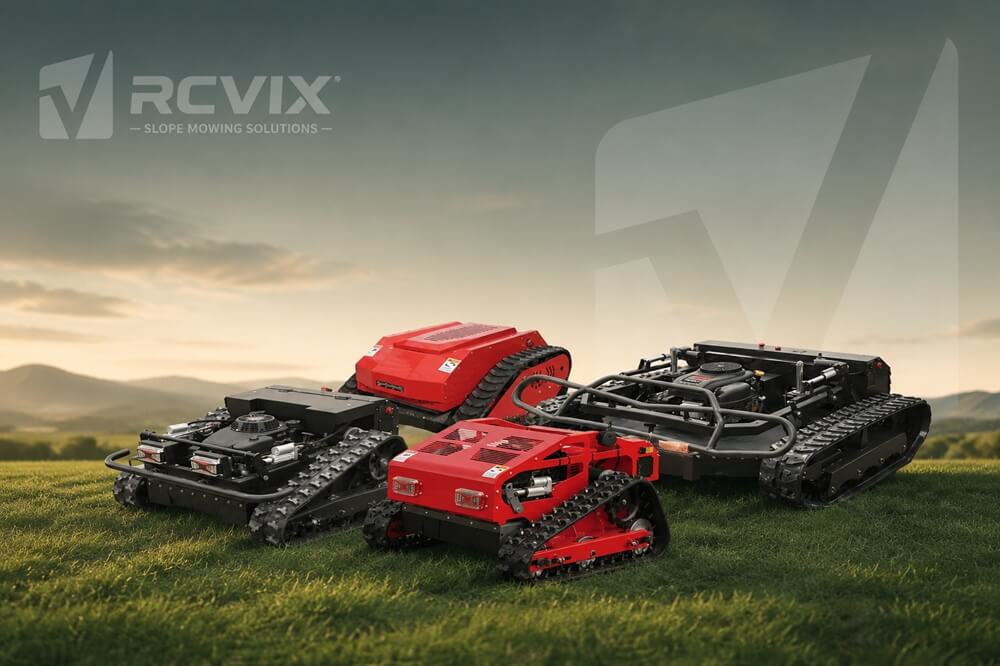
Wider cuts faster on open ground but will not fit narrow rows. Measure your tightest gap and buy margin under it. A 500 mm wheeled unit suits open blocks; a 550 mm tracked unit suits slopes and rough ground; a 1000 mm flail unit suits wide, heavy clearing.
5. Confirm the operator essentials
- Transmitter range covers your longest run.
- An instant emergency stop you can reach without looking.
- Clear line-of-sight operation (never operate blind around banks or buildings).
- Spare parts availability and a support contact.
6. Think about the partnership, not just the unit
If you will resell or brand the machine, the supplier's OEM, ODM and private-label options matter as much as the steel. See our OEM/ODM explainer and the distributor program.
Frequently asked questions
Q: What is the single most overlooked factor?
A: Slope rating. Buyers often size for flat speed, then meet a bank the machine cannot safely climb.
Q: Flail or rotary for a mixed farm?
A: Flail, almost always — it handles the scrub the rotary would clog on.
Q: How do I know runtime is enough?
A: Multiply your longest single session by a safety factor of 1.3; if a charge cannot cover that, choose hybrid.
Next step
Tell us your slope, surface, access width and daily hours and we will match a unit from the T550, W500 and F1000 range. Contact us.

Related Products
Professional-grade solutions for your operational requirements


Related Articles
Frequently Asked Questions
Yes. RCVIX actively cooperates with distributors, dealers, and industrial equipment partners in multiple international markets.
Regional exclusivity may be considered depending on market potential, sales capability, and long-term cooperation plans. Specific terms are evaluated individually.
Yes. Relevant shipping documents such as commercial invoices, packing lists, and transport documentation will be provided according to the shipment arrangement. Tracking information is provided where available through the logistics provider.
Our equipment is designed for demanding outdoor applications such as slopes, vegetation management, and industrial terrain operations. However, operating conditions such as extreme weather, unstable ground, or excessive moisture may affect performance and safety.
Need a Custom Solution?
Our team of experts is ready to help you find the perfect vegetation management solution for your specific needs. Get a free consultation and quote today.
